
You can view the finished work here.
Corte Nuova by the Arsenal.
11 May–23 November 2026
And 50 metrer is my other installation IMAXENA
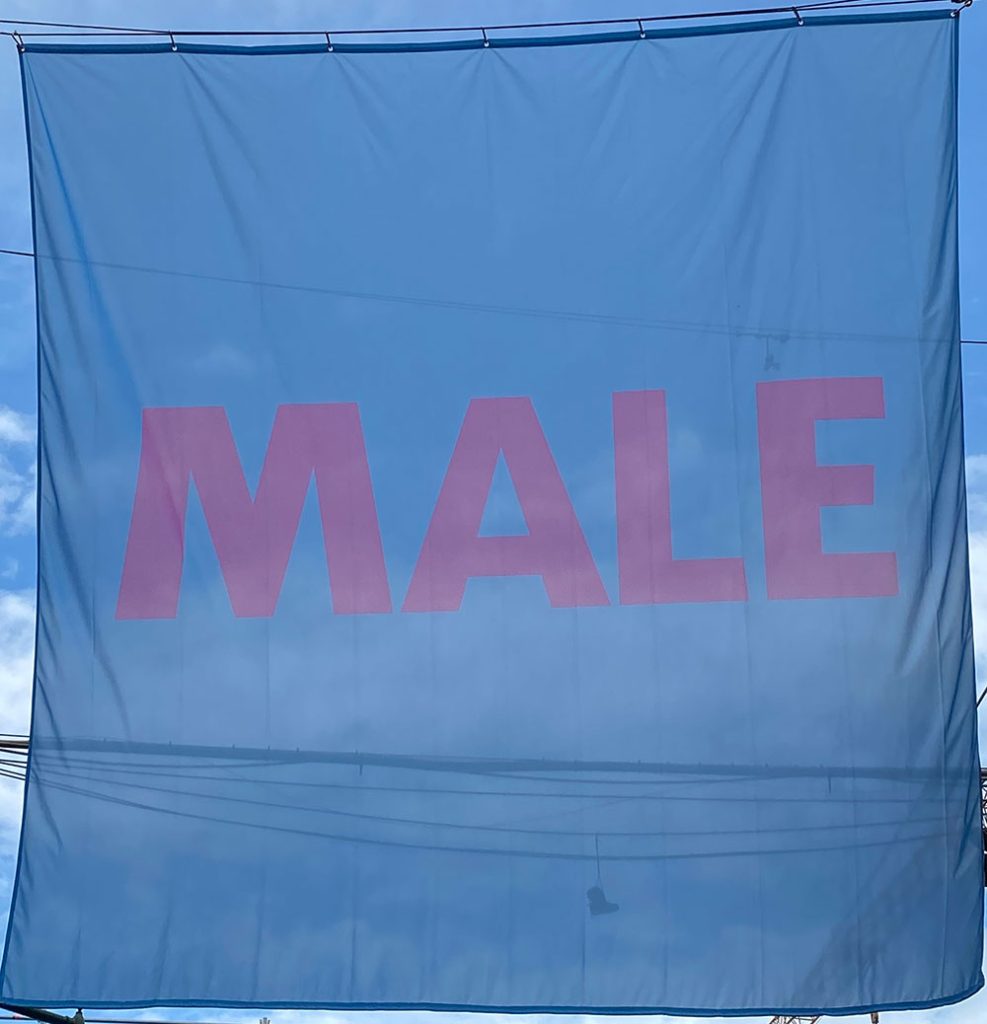

Flag 3mx3m in the Corte Nuova by the Arsenale di Venezia
In Italian, il Male. In English, the Male. This collision is no accident — it is a question cast to the wind, hanging in the Venetian air like a doubt adrift. Is the Male Evil?
A flag is by nature an emblem of belonging, an assertion. Here, it turns against itself. It asserts and questions at once. It claims nothing — it suspends.
Floating near the Biennale, this flag without nation or camp speaks to all the masculinities that doubt, that search, that resist injunctions — whether they come from tradition or modernity.
Bandiera 3 m x 3 m per le strade di Venezia
In italiano, ‘Il Male.’ In Inglese, ‘The Male’. Questo scontro non è un caso, ma è una domanda posta al vento, che aleggia sospesa nell’aria di Venezia come un dubbio fluttuante. The Mâle è il Male?
La bandiera è per sua natura un emblema di appartenenza, un’affermazione. Qui, si rivolta contro se stessa. Afferma e interroga allo stesso tempo. Non rivendica nulla, ma sospende, cioè mette in attesa.
Sventolando vicino alla Biennale, questa bandiera senza nazione né schieramento si rivolge a tutti coloro di sesso mascolino che dubitano, che cercano, che resistono alle imposizioni, siano esse provenienti dalle tradizioni o dalla modernità.
Drapeau 3mx3m dans une rue à Venise.
En italien, il Male. En anglais, le Mâle. Cette collision n’est pas un accident — c’est une question posée au vent, accrochée dans l’air de Venise comme un doute qui flotte. Le Mâle est-il Mal?
Le drapeau est par nature un emblème d’appartenance, une affirmation. Ici, il se retourne contre lui-même. Il affirme et interroge en même temps. Il ne revendique rien — il suspend.
Flottant près de la Biennale, ce drapeau sans nation ni camp s’adresse à toutes les masculinités qui doutent, qui cherchent, qui résistent aux injonctions — qu’elles viennent de la tradition ou de la modernité.
Traduzione e adattamento dal francese all’italiano a cura di Annamaria Biroccio.